Harry Chapin
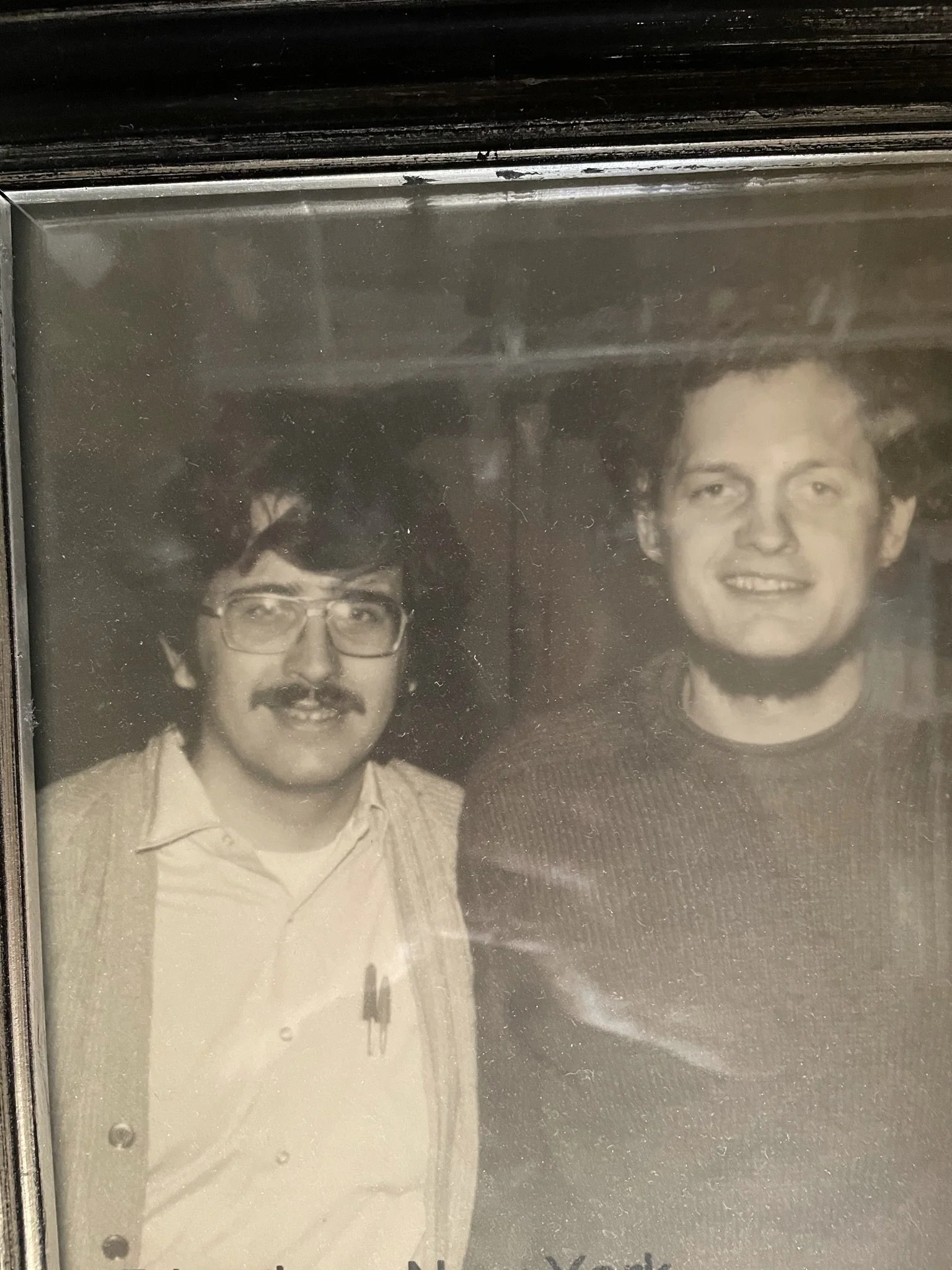
The author and Harry Chapin, 1972
“Being an American means never giving less than your all in a world of need.”
By John G. Taylor
Blessed and cursed, reporters plunge into strangers’ lives, memorializing moments, vanishing as lives evolve.
Consider the rare and wonderful Harry Chapin, singer of story songs and humanitarian, whom I interviewed twice before a freeway tragedy claimed him at age 38.
He was inspiration when I changed careers.
In 1972, I was freshly graduated from New York University, a newlywed and a $1.85-an-hour rookie weekly newspaper reporter in Brooklyn, N.Y., who’d just gotten his draft notice.
Fueled by free albums and concert tickets, I wrote a music column for the paper, hoping to gain visibility.
In 1972, Harry Chapin was fresh magma, a onetime Brooklyn choir boy whose story songs pulsed the national airwaves.
I met him at Bananafish Park, a Brooklyn neighborhood pub that was one of his last small venues as acclaim grew.
Weeks later, he welcomed me into his Long Island home for Sunday dinner before his last concert of 1972.
I told him the Sunday New York Daily News was interested in a story although my publicity pitch was puny – they said they’d “take a look,” eventually rejecting my submission.
Chapin overrode the ordinariness of Seventies radio with poignant, pointed and sometimes macabre tales.
· “Taxi” – one of his biggest hits, about a weary cabbie’s last nightly fare which reunites him with a former flame.
· “30,000 Pounds of Bananas” -- a truck driver realizes he’s losing control on a perilous Pennsylvania road.
· “Sniper” -- a madman-marksman inflicts misery from a Texas university tower.
· “Better Place to Be” -- a solitary drinker and his closing-shop bartender take a chance.
· “Cats in the Cradle” – self-scolding for years invested in career instead of family. You’ll find a bit of the same in “All My Life’s a Circle.”
Chapin was friendly, sincere, fierce, funny, disarming, relentless, self-assured and always self-effacing.
Audiences loved his over-the-back-fence genuineness and lunch-counter realism.
He was seven years older and legions more worldly than I. I wanted his observational skills, the clarity of his wordsmithery. He was the brother I didn’t have.
Our interview included his falsetto-singing friend and fellow band member John Wallace, Harry’s wife Sandra and a passel of their happy kids coveting dad’s time.
Chapin was neither submerged in nor impressed by himself.
Describing his voice: “An instrument that spits out lyrics clearly.”
His song’s remote locales: “That’s where all the fun things happen. One of my gifts is to make the strange, incomprehensible things more understandable.”
His choice of protagonists: “My songs are about people who are not in the bright sector of society. It all comes down to the substance of real difference versus the appearance of real difference.”
Consider the killer in “Sniper”:
“He looks at the city where no one had known him. He looks at the sky where no one looks down. He looks at his life and what it had shown him. He looks for his shadow. It cannot be found.”
Chapin studied to be an air force pilot, then moved to architecture and philosophy at Cornell, worked on an award-winning boxing documentary and got a taxi license.
“I’ve been fortunate enough to have the lack of intestinal fortitude to put up with things I really didn’t care for in the long run.”
Two impressions lingered after I shook his hand for the last time.
He was comfortable on the national stage and aware that, for some, he was the latest marketing flavor of the month.
My keenest takeaway --- he was pensive, waiting to be seized by something larger.
His “ah-ha moments” had occurred when we talked by phone in 1979 for the last time. One of his kids had gotten hurt in a sports mishap, scrambling our interview and my Milwaukee Sentinel deadlines.
His sights were on remedying world hunger. Wow, just flat out, wow.
There was no waffling in his transformation: “What do you do with gold albums after a while? Make them into Frisbees?”
He’d been to Africa, seeing famine in Ethiopia. He networked with advocates, lobbying Congress.
Food scarcity was not the issue. He believed hunger was a distribution issue and, especially, lack of political will.
He frustrated his music overlords who considered advocacy a cash-diluting affliction.
They put him on a different tier than other troubadours --- John Prine, Gordon Lightfoot, Billy Joel and Randy Newman.
But Chapin also enlisted these colleagues, staging a one-time benefit concert in 1979 called “Four Together --- Concert for World Hunger.” Joining him in Detroit were Lightfoot, James Taylor and John Denver.
Chapin donated proceeds from half his annual 300 concerts to fighting hunger, sometimes squeezing his own family budget.
After his death, stories quoted his widow Sandy: "Harry was supporting 17 relatives, 14 associations, seven foundations, and 82 charities. Harry wasn't interested in saving money. He always said, 'Money is for people,' so he gave it away."
He put it this way, my notes said: “I’ve decided in the second half of my life to go for it … the whole ball of wax. I’m frightened by the thought of being old and not having done what I wanted to.”
It blew his mind that the world’s breadbasket still left many needy on streets and byways.
Don’t just sing, he told himself, say something empowering – scold and encourage.
Artistry fed arm twisting to nourish the needy. His song content changed.
Moral allegories – not blaming inert politicians by name -- held sway in songs such as “The Mayor of Candor Lied” and “The Rock,” the latter a clarion call against needless suffering and death, pitting selflessness vs. indifference.
He co-founded World Hunger Year (later Why Hunger), served on President Carter’s Commission on World Hunger and was posthumously awarded the Congressional gold medal for national service.
His legacy includes Long Island Cares, which serves as the primary food bank for Nassau and Suffolk counties.
In 1979 I thought he was a little crazy for not relishing his financial rewards at least briefly. But I was a slow learner. My career crossroads arrived in 2001 as I hit my 50s.
The printed newspapers that I called home for 30 years were belatedly retooling to respond to the Internet and social media.
I thought they were neglecting public service in chaotic efforts to click-bait their way to relevance.
Like Chapin, I turned to advocacy. Communicators were supposed to be heralds of change, so I took my notebooks and red pens to a nonprofit healthcare system, Community Medical Centers, based in Fresno, CA, as the ground-breaking Affordable Care Act redefined medicine.
I was never bored, never so frustrated and certain I made the right course correction.
Chapin and I certainly heard the same social-justice clarion calls -- Being an American means never giving less than your all in a world of need.
It meant responding to President John Kennedy’s entreaty: “Ask not what your country can do for you, but what you can do for your country.”
There was an echo in the Rotary International’s motto: “Service Before Self.”
Maybe that explains why my personal favorite Chapin song was “Greyhound” with epiphanies born from wearisome bus rides where you wonder if you’ve wasted yourself.
He concluded: “It’s got to be the going not the getting there that’s good.”
My career change was born of reflecting on how Chapin reinvented himself. My lesson: When you think you’ve arrived, maybe you’re just starting.
If you’d like to reach me, email: jtcommunicates@comcast.net